
ON THE NEWS FRONTS OF THE WORLD. SCOPE EXCLUSIVE INTERVIEW: CLOSE-UP OF A TERRORIST LEADER
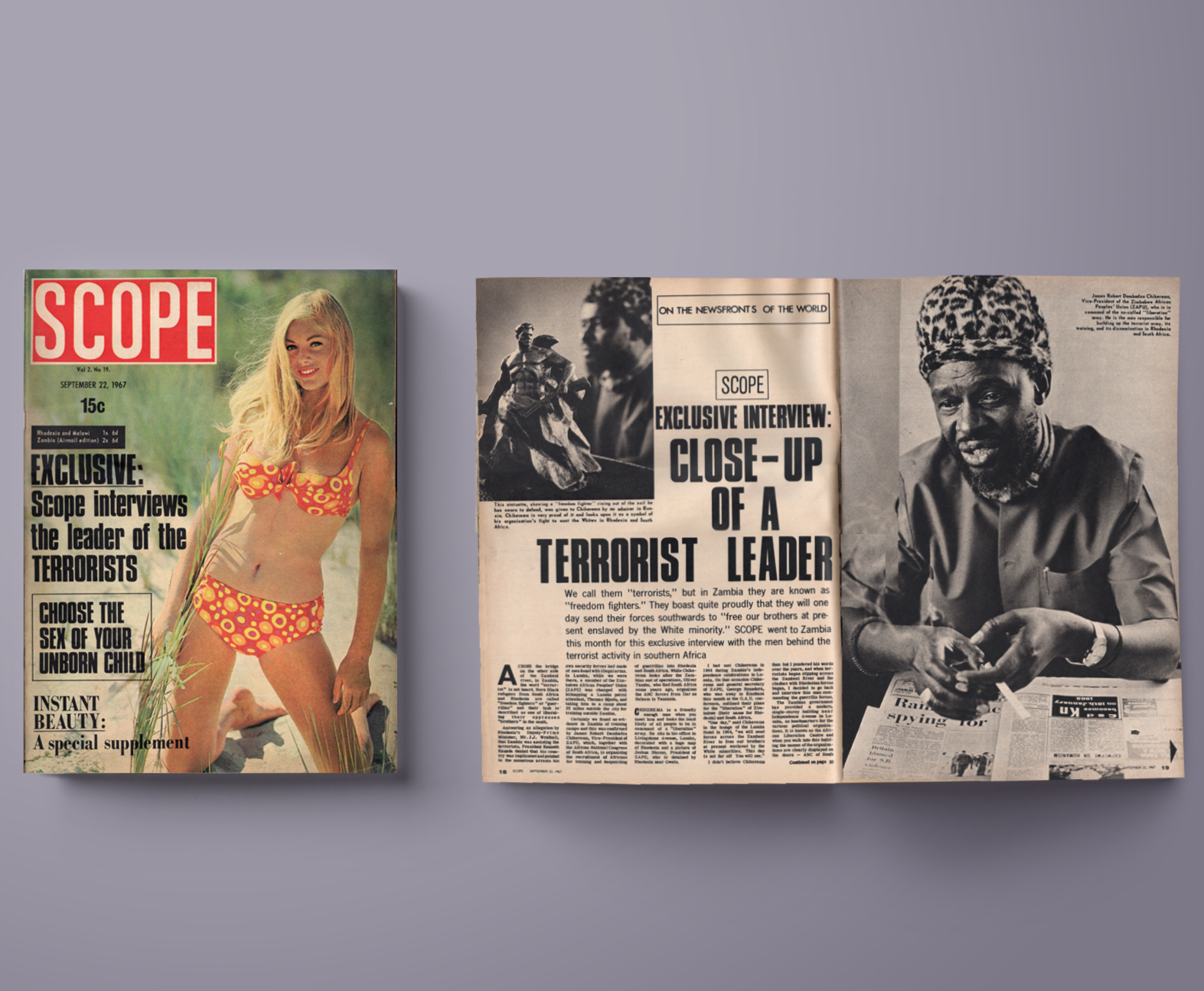
First published Scope Magazine 22 September 1967
We call them “terrorists,” but in Zambia they are known as “freedom fighters.” They boast quite proudly that they will one day send their forces southwards to “free our brothers at present enslaved by the White minority.” SCOPE went to Zambia this month for this exclusive interview with the men behind the terrorist activity in southern Africa.
Across the bridge on the other Side of the Zambezi river, in Zambia, the word "terrorist" ls not heard. Here Black refugees from South Africa and Rhodesia are called "freedom fighters" or "guerrillas" and their task is described as one of liberating their oppressed brothers in the South
Answering an allegatlon by Rhodesia's Deputy-Prime Minister, Mr. J.J. Wrathall, that Zambia was assisting the terrorists, President Kenneth Kaunda denied that his country was implicated and pointed to the numerous arrests his own security forces had made of men found with illegal arms. In Lusaka, while we were there, a member of the Zimbabwe African Peoples Union (ZAPU) was charged with kidnapping a Lusaka petrol attendant, Thomas Mpofu, and taking him to a camp about 25 miles outside the city for training outside Zambia.
Certainly we found no evidence In Zambia of training camps and this was confirmed by James Robert Dambadza Chikerema, Vice-Presidentof ZAPU, which, together with the African National Congress of South Africa, is organising the recruitment of Africans for training and despatching of guerrillas into Rhodesia and South Africa. While Chikerema looks after the Zambian end of operations, Oliver Tambo, who fled South Africa some years ago, organises the ANC forces from Dar es Salaam in Tanzania.
Chikerema is a friendly enough man when you meet him and looks the least likely of an people to be in command of a "liberation" army. He sits in his office ln Livingstone Avenue, Lusaka, decorated with a huge map of Rhodesia and a picture of Joshua Nkomo, President of ZAPU, who is detained by Rhodesia near Gwelo.
I had met Chikerema in 1964 during Zambia's lndependence celebrations in Lusaka. On that occasion Chikerema and general secretary of ZAPU, George Nyandora, who was away in Kinshasa this month at the O.A.U. conference, outlined their plans for the "liberation" of Zimbabwe- (their name for Rhodesia) and South Africa.
"One day," said Chikerema in the lounge of the Lusaka Hotel in 1964, "we will send forces across the Zambezi River to free our brothers at present enslaved by the White minorities. This day ls not far off. You will see."
I didn't believe Chikerema then but I pondered his words over the years, and when terrorists began slipping across the Zambezi River and the clashes with Rhodesian forces began, I decided to go back and interview this man commanding the guerrilla forces. The Zambian government has provided a modern, single-storey building near Independence Avenue tn Lusaka, as headquarters for the various political organisations. It ls known as the African Liberation Centre and when you walk Into this building the names of the organisations are clearly displayed on the doors - ANC of South Africa, PAC. (both banned in South Africa) and ZANU (Zimbabwe African National Union, and a rival to ZAPU). (Continued on page 20)
(Continued from page 18) A Government official, specially appointed by President Kaunda, sits in an office near the entrance. His job is to keep an eye on the refugees and make sure that they behave themselves while enjoying the hospitality of Zambia. Kaunda, while denying that Zambia is assisting the invasion of Rhodesia, concedes that Zambia has given political asylum to these refugees. This is in line with his policy of working towards a one-man-one-vote system of government in the territories south of Zambia.
We walked into the African Liberation Centre and were asked to sign our names and state our business in a register at the entrance. Then we were ushered into the office of ZAPU. Chikerema was absent on that day and we were told that he seldom visited the centre. After a telephone call we were taken to the "secret" headquarters of ZAPU in Livingstone Avenue. We spoke to George Silundika, national secretary for publicity and information of ZAPU. At first our reception was cool and there was an air of suspicion surrounding our interview. This is natural enough because Zambia is rife with rumours of Rhodesian spies.
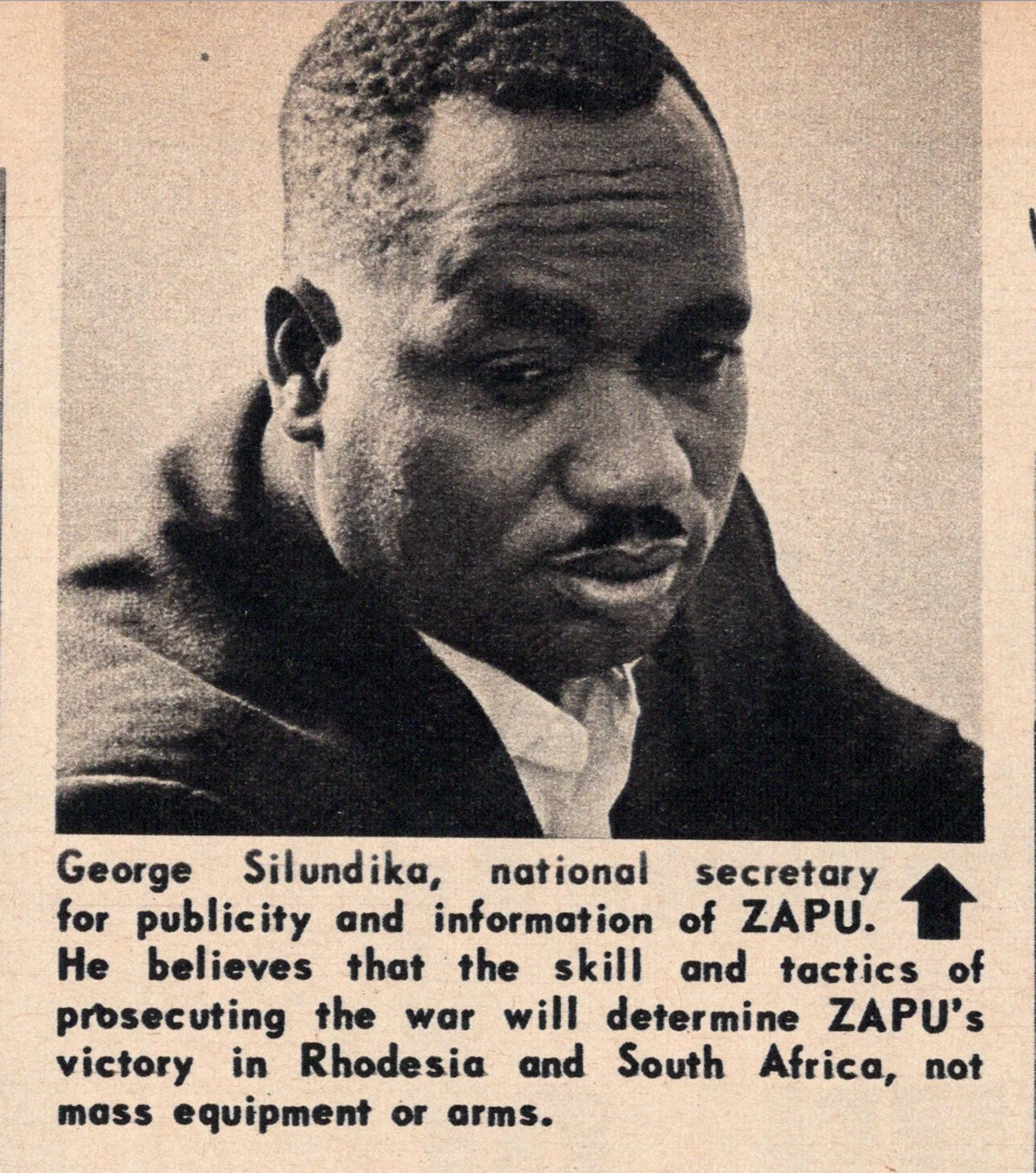
George Silundika, National Secretary for publicity and information of ZAPU.
On that very day, as we sat in the office with Silundika, a man called Brian Fitch, who worked on the railways at Kitwe, was arrested by Zambian security forces and charged with spying for Rhodesia. A few months before, five other Whites were detained in dawn swoops and in May, Mrs. Doreen Fleming, a Lusaka farmer, was also detained on a spying charge. All were subsequently released and deported, except Mrs. Fleming, who was allowed to return to her farm.
As soon as I had produced evidence of my bona fides as a journallst, Silundika's attitude changed.
"We have no illusions about the power of the Rhodesian and South African armies," he said. "What determines a victory is not mass equipment or arms but the skill and tactics of prosecuting a war. Our men are well trained and well disciplined and will give as much as they take."
There is no doubt that the terrorists crossing the Zambezi are highly skilled in guerrilla warfare. Even official Rhodesian statements acknowledge that the terrorists are tough and well trained. Rhodesian security offlcers, expecting only slight resistance, have been surprised at the fighting their men have encountered. "They put up quite a fight and they appear to have been better trained and to be more determined than most of the terrorists who have crossed into Rhodesia before," said one army officer.
THE next day at the Lusaka Hotel, Silundika brought a message. "Chikerema will see you at three o'clock this afternoon," he said. And so we returned to the ZAPU offices to meet the man who freely admits that he is sending his men on a tough and dangerous mission against superior forces and equipment. "Suicide? Maybe, but for a cause - the freedom of their country."
Chikerema sat behind his desk, covered in airmail editions of British newspapers, and wearing a familiar monkey-skin hat. There is a strict. security check at the door to the building. No one enters here unescorted by a ZAPU member. Names are taken and business must be stated clearly and precisely.
Chikerema remembered me from our earlier meeting and it was this which doubtless persuaded him to talk. There is no viciousness in his voice and his words are spoken calmly and reasonably.· He spoke of the ambitions of ZAPU saying that the"current fight between the freedom fighters and the fascists is a continuation of our armed struggle to free our country from the White oppressive minority dictators."
"How are things in Rhodesia?" he asked and I had to admit that I knew nothing further than what had been published in Rhodesian newspapers, which are banned in Zambia.
"They're fools in Rhodesia," he said. "They don't want the public to know anything, but information we have is that the Rhodesian Public are becoming increasingly alarmed about our activities. This is a war of brains and we believe that we have the brains to outwit our enemies."
Naturally enough, Chikerema would not disclose where his "troops" are being trained. "I can tell you this, though. Any allegation that we are training these men in Zambia ls false. We have other international forces which are helping us to the best of their ability. No, I cannot tell you who they are but you would be surprised if I did."
How many men are there waiting to cross the border? Chikerema would not give a figure but he conceded that there were more than 1,000 and less than 2,000. "A figure somewhere between these two would be more accurate than any quoted ln Rhodesia or in South Africa," he said.
Where then are these men being trained and what is the sort of training they receive? Some say that training camps have been established in Tanzania and in Algeria but from what Chikerema hinted, I gather that most of the men have attended courses overseas.
From another source, I learned that the syllabus for African guerrilla recruits is roughly as follows:
Demonstration of explosives and grenades and thelr classification.
Explanation of detonators and fuses and the correct use of explosives.
Planning of sabotage operations and the use of explosives against houses, railway lines, bridges, tanks, guns, lorries, tractors, diesel engines and aeroplanes.
Once the pupils have absorbed these details, there is a revision course and an examination. Then the would be guerrillas are taught the manufacture and application of explosives from easily obtainable materials. By the time they have completed this part of the course, they are adept ln making home-made incendiaries, mines and grenades. In addition they are skilled in undertaking operations at night.
all form part of the syllabus. They graduate with a general knowledge which will enable them to undertake a "war" in their own countries, where they are familiar with the terrain and local conditions.
Such courses are conducted ln RussJa and in China and when the recruits are ready they are sent back to Africa where they wait tor the signal to return to their own countries. It ls believed that the terrorists now active in Rhodesia arrived in Zambia by road from Tanzania. Their arms and ammunition are smuggled into the country by devious routes and the guerrillas rally at certain spots where last-minute instructions are given to them, away from the prying eyes of officials. Each is handed a sum of money, which could be as much as R50, together with semi-automatic rifles, hand grenades and ammunition, Some also carry rockets and rocket launchers which have been made in Russia and in China.
On a selected night they move towards the banks of the Zambezi River which is the border between Zambia and Rhodesia. Some of the terrorists have taken the ferry at the confluence of the Chobe and Zambezi Rivers where four territories meet -Rhodesia, Botswana, Zambia and the Caprivl Strip. Others have slipped across the river in dug-out canoe s between Kazangula and the Victoria Falls. Many have also come across the river north of Lake Kariba.
Chikerema claims that the "freedom fighters" are trained to march 40 miles a night. This is difficult to believe because each man would probably be carrying about 30 lb. of equipment. The terrorists wear uniforms and army boots. Pictures showing what they look like have been distributed to farmers along the Limpopo River by South African security forces. Farmers on the banks of the Limpopo know what to expect and are constantly alert for the distinctive footprints which would betray the infiltration of terrorists into South Africa.
Chikerema told me that the first large batch of terrorists crossed the Zambezi River at the end of July and their first engagement with Rhodesian forces was on August 12. There must obviously be some lines of communication with headquarters in Lusaka because the "Zimbabwe Review," a newspaper published by ZAPU, carries full reports of battles and boasts of heavy casualties among Rhodesian forces. These figures bear no relation to those released by official Rhodesian sources.
I asked Chikerema whether any of his men had reached South Africa. At first he was reluctant to admit to anything but in a later interview he conceded that some might have completed their journeys and reached their destinations.
"Is this not a suicidal mission?" I inquired. "Considering the strength of the forces against them, don't these fighters of yours realise that they stand very little chance of surviving?"
"They are all dedicated men," Chikerema explalned. "They have been well trained and each carries weapons that are just as good as, if not better than, those belonging to their opponents. They have their instructions and they are carrying them out to the letter."
"How long will the war continue?” I asked. "We have many men who are being trained and as long as there are minority gowvernments down south we will continue fighting. I can tell you that this war will increase in intensity against the White settler dictatorship."
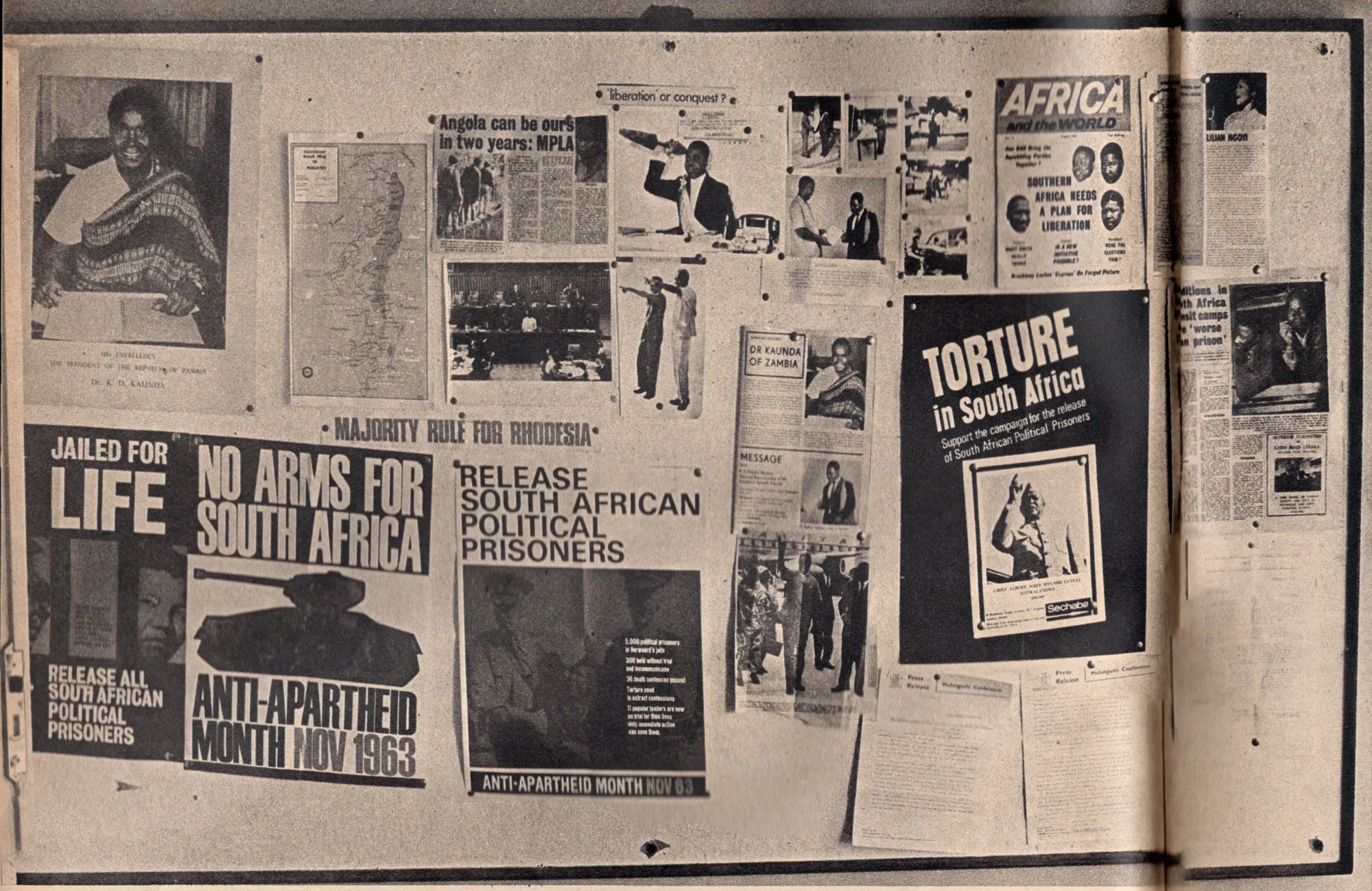
Caption: (sic)This is the entrance to the African Liberation Centre in Independence Avenue, Lusaka. All political organisations, most of them exiled from their own countries, have offices here where they enjoy the hospitality of the Zambian Government.
What has caused this sudden move against Rhodesia and South Africa? The answer probably lies ln Chikerema’s statement: "We are confident that in the end the freedom fighters will win the battle, not necessarily on the bloodsoaked soil of Rhodesia but maybe in the conference rooms overseas where our friends are fighting verbal battles on our behalf."
Last week in Kinshasa the Organisation for African Unity had its annual meeting and It is almost certain that decisions were taken to intensify the support for African "freedom fighters" in view of recent armed clashes ln Rhodesia. In addition, at Whitehall, Britain's Prime Minister, Harold Wilson, announced a resumption of informal talks with the Rhodesian Prime Minister, Ian Smith. From this, it can be seen that Chikerema’s move against hls homeland has been well timed.
SCOPE | SEPTEMBER 22, 1967
*Produced in the apartheid era, this publication reflects the language, attitudes, and social context of its time and may contain content that some readers find offensive or distressing.